Mai Japanese modernism · 1981
Scroll down for the full brand identity study.
Mai
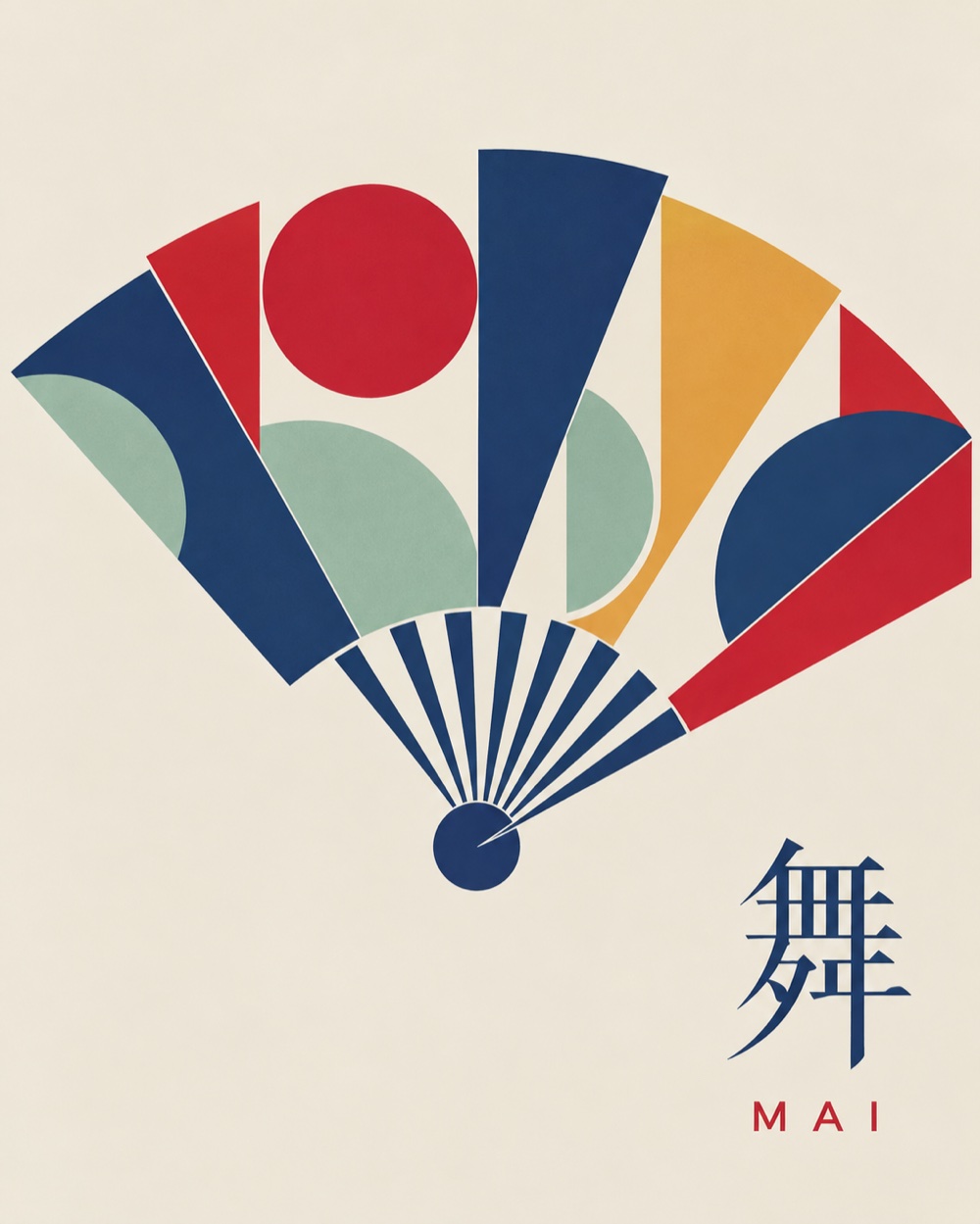
Draw a traditional subject with a modern tool. The tension between the two is what makes people look.
↓ Scroll to the Mai brand identity system below · View in the archive
Prints are in preparation and are not available to order yet. Frame and room views are visual simulations; they do not confirm the final product, scale or finish.
The identity system below documents the original design study, made before the current poster artwork.
Drawn with a compass and a ruler. Nothing else.
日本舞踊
Mai is a small theatre in Osaka that stages classical Japanese dance four times a year. The dancers are never pictured. Instead, every piece rebuilds a traditional subject from squares, circles and arcs: the open fan is a half circle, the long sleeve two rectangles, the family crest three dots. The subject is centuries old and the method is modern. The tension between the two is what makes people look.
- Client
- Mai, theatre of classical dance
- City
- Osaka
- Style
- Japanese modernism
- Year
- 1981
- The rule
- Squares, circles and parts of them only. Flat colour. Half the ground stays empty.
Mark
An open fan over two squares, drawn on a single module of 120 units. The half circle is the fan, the squares are the stage, and the crest of three dots marks the house. Every edge is either a straight line or an arc from one of three centres.
MAI
舞 · 大阪
Jost Bold in capitals, set tight. The Japanese sits below in vermilion, or runs vertically down the right edge on tall formats.
Lock-up on paper
The crest on indigo
Under 8 mm: three dots only
The rule running
Compose on the four-by-four module. Click a square to cycle it through the allowed shapes: square, quarter circle, half circle, full circle, then empty again. The meter measures how much ground you have covered. Past half, the subject loses its air.
Start from
HoldsFlat colour, and most of the ground is still empty.
Colour
A restrained traditional palette, each colour named after its dye or pigment. Paper is always the largest area. Vermilion appears once per piece, usually in the crest. Every colour is flat: no tints, no shading, no texture.
The ground. At least half of every piece.
The heaviest shape and all text on paper.
The quiet partner to indigo.
Warmth. Fans, sashes, lanterns.
Once per piece. Usually the crest.
Type
Zen Kaku Gothic for Japanese and Jost for Latin: both geometric, both without flourish, so neither argues with the shapes. Japanese runs vertically on tall formats. Latin is always set level and always smaller than the picture.
Display · Zen Kaku Gothic Black and Jost Bold
春の会
MAISpring programme · 1981
Text · Jost Regular 17 / 28
Four dances in the spring programme, performed twice nightly from 3 April. The theatre seats two hundred. Please arrive before the drum.
- JapaneseZen Kaku Gothic 900 for titles, set vertically on posters and tickets.
- LatinJost 700 capitals for the name. Jost 400 for text.
- ScaleType never outweighs the picture. The shapes are the headline.
Applications
Each season gets its own subject, rebuilt from the same shapes: the fan for spring, the crane for autumn. The layout stays fixed. Picture in the upper two-thirds, Japanese down the edge, name and dates along the foot.
Voice
Seasonal, courteous and brief. Mai writes the way a programme note is read in the interval: a few facts, one image, and room to think.
Four dances. One fan. Arrive before the drum.
Line for the spring programme. The Japanese carries only the season: 春の会.
Mai saysThe spring programme runs from 3 to 19 April.
NotExperience the magic of ancient Japan like never before.
- Name the season. Every programme is tied to a time of year, and says so first.
- Say less than you know. One image in words, then the facts. Leave the rest to the dance.
- No exotic framing. The dances are not mysterious or timeless. They are performed on Tuesday at six.
- Japanese first. Titles are written in Japanese and translated, never the other way round.
What breaks it
The discipline is the point. One freehand curve or one shaded surface and the picture turns from construction into illustration.
- A freehand lineAny curve that is not an arc from a centre point breaks the construction. The subject becomes a drawing of a fan, not a fan made of geometry.
- Shading or textureGradients give shapes volume. Mai's shapes are flat cut paper.
- A full groundWhen shapes cover more than half the surface, the empty space that frames the subject disappears.
- A picture of the dancerFaces and figures pull the work back to photography. The subject is always a prop, a costume or a crest.
Lesson for students and teachers: Japanese modernism, 1981
The rule behind Mai
Draw a traditional subject with a modern tool. The tension between the two is what makes people look.
Ikko Tanaka · posters for Japanese theatre and dance · 1975–85
Learn how it works
Tanaka rebuilt traditional Japanese subjects from a handful of flat geometric shapes, drawn with compass and ruler. Here the dancer is never shown: the open fan is a half circle, the long sleeve two rectangles, the family crest three dots. The subject is centuries old, the method is pure Bauhaus.
Learn to spot it
A subject built from squares, circles and arcs, flat unshaded colour, a restrained Japanese palette of indigo, vermilion, ochre and pale green, and a lot of empty ground.
Use the idea yourself
Draw a traditional subject with a modern tool. The tension between the two is what makes people look.
Make something (10 minutes)
Take a traditional subject, like a flower or a mountain, and redraw it with a modern tool: a spreadsheet grid, pixels or your phone.
Talk about it
“Does a new tool change what the subject means?”