Blocco Memphis · 1981
Scroll down for the full brand identity study.
Blocco
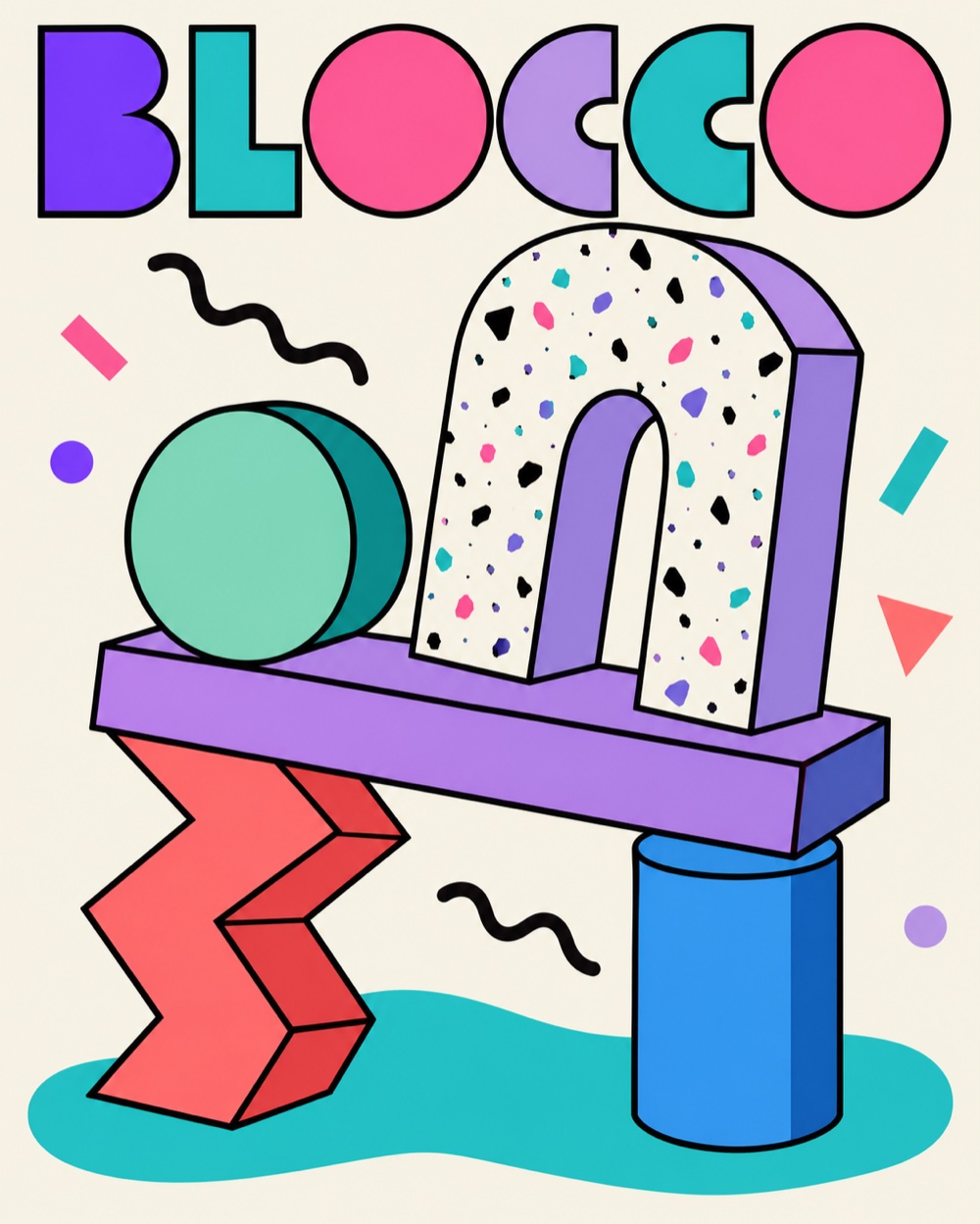
The black keyline. It lets genuinely incompatible colours sit next to each other without curdling.
↓ Scroll to the Blocco brand identity system below · View in the archive
Prints are in preparation and are not available to order yet. Frame and room views are visual simulations; they do not confirm the final product, scale or finish.
The identity system below documents the original design study, made before the current poster artwork.
Blocco
A stationery house with forty products and no photographs. Every notebook, roll of tape and box is covered in a pattern from one library, and the library is small enough that the range looks like a family from across a shop floor.
- Client
- Fictional, self-initiated
- Sector
- Stationery and paper goods
- Scope
- Mark, pattern library, packaging, retail, screen
- Method
- After Sottsass and Du Pasquier
- Built
- CSS gradients, no image files
The mark
One word, set tight, with a dot doing the work an ascender would. The dot is the only part that ever changes colour, and it takes whichever shout the product is wearing.
Primary lockup with a pattern flag
- The dot
- Replaces the final letter. It is a full circle with a black keyline, never an outline or a ring.
- Colour
- The dot takes the shout of the pattern beside it. On its own it is pink.
- Keyline
- Three points at every size. It is what lets the mark sit on any pattern in the library.
- Never
- Never set the mark on a pattern without the keyline, and never fill the dot with a pattern.
The library
Seven marks, four shouts, and a rule that a pattern uses exactly two colours. That gives more combinations than the range will ever need, and every one of them is already approved.
- Fixed
- The seven marks and their scale. A pattern is never enlarged or rotated to fit a product.
- Chosen
- Two colours, from the four shouts plus cream and black.
- Squiggle
- Always black, on any ground. It is the one mark that does not take a colour.
- Adjacency
- Two patterns never touch without a black keyline between them.
The closed set, seven marks
Colour
Four shouts, a cream and a black. The shouts are all roughly the same value, which is why they need the keyline. Without it they vibrate against each other and nothing reads.
#3FD3B8Writing goods. Notebooks, pads, refills.#FF7BACThe mark's dot, and anything sold as a gift.#FFC93DPrices, offers and the shop front.#7557F3Filing and storage. The dullest category gets the loudest colour.#111111Every keyline and all type. Three points minimum.Typography
A geometric sans that goes very heavy and very light and skips the middle, plus a monospace for anything a shop assistant has to read off a label.
Outfit 800Layflat A5
Outfit 600Ruled, dotted or plain
Outfit 300, 16 / 26Sewn in sections so it opens flat and stays open, which is the only feature worth putting on the front of a notebook.
DM Mono, trackedA5 · 160 pp · 100 gsm · £14
- Weights
- Only 800 and 300. The middle weights are not licensed, so nothing can drift towards ordinary.
- Tracking
- Display is set at minus five per cent. The mono is the only thing tracked open.
- On pattern
- Type never sits directly on a pattern. It sits on a white panel with a keyline.
The range
Three notebooks from the writing line. Identical construction, identical label, and the pattern is the only thing that tells them apart on a shelf.
Writing line, three of nine
Applications
On tape the pattern wraps with no label at all. On a box it becomes a band. In the shop it is the only thing doing the selling, because there is nothing to photograph.
Tape, 15 mm, four of the library
Gift box, 210 × 160 mm
Forty things
for a desk
Sewn notebooks, paper tape and box files, made in one factory in Lombardy and patterned in seven ways.
Shop the rangeWebsite
patterns
in
Seven marks, four colours, and a shelf that finally matches.
Point of sale card, A4
What breaks it
Memphis looks like it has no rules, which is exactly why it needs written ones. Remove any of these four and the range stops looking like a range within a season.
Lesson for students and teachers: Memphis, 1981
The rule behind Blocco
The black keyline. It lets genuinely incompatible colours sit next to each other without curdling.
Ettore Sottsass and Nathalie Du Pasquier · Memphis Milano · 1981
Learn how it works
Du Pasquier drew the patterns, Sottsass built the objects. The Bacterio squiggle field was a plastic laminate first. Everything is a surface applied to a shape that does not need it, and that mismatch is the joke.
Learn to spot it
Squiggle fields, terrazzo confetti, clashing pastels held in place by heavy black keylines, and no grid at all.
Use the idea yourself
The black keyline. It lets genuinely incompatible colours sit next to each other without curdling.