Nulya Suprematism · 1916
Scroll down for the full brand identity study.
Nulya
Remove the horizon. Once nothing is standing on anything, a few tilted shapes feel like movement.
↓ Scroll to the Nulya brand identity system below · View in the archive
Prints are in preparation and are not available to order yet. Frame and room views are visual simulations; they do not confirm the final product, scale or finish.
The identity system below is drawn from the Remade poster.
Every shape leans the same way.
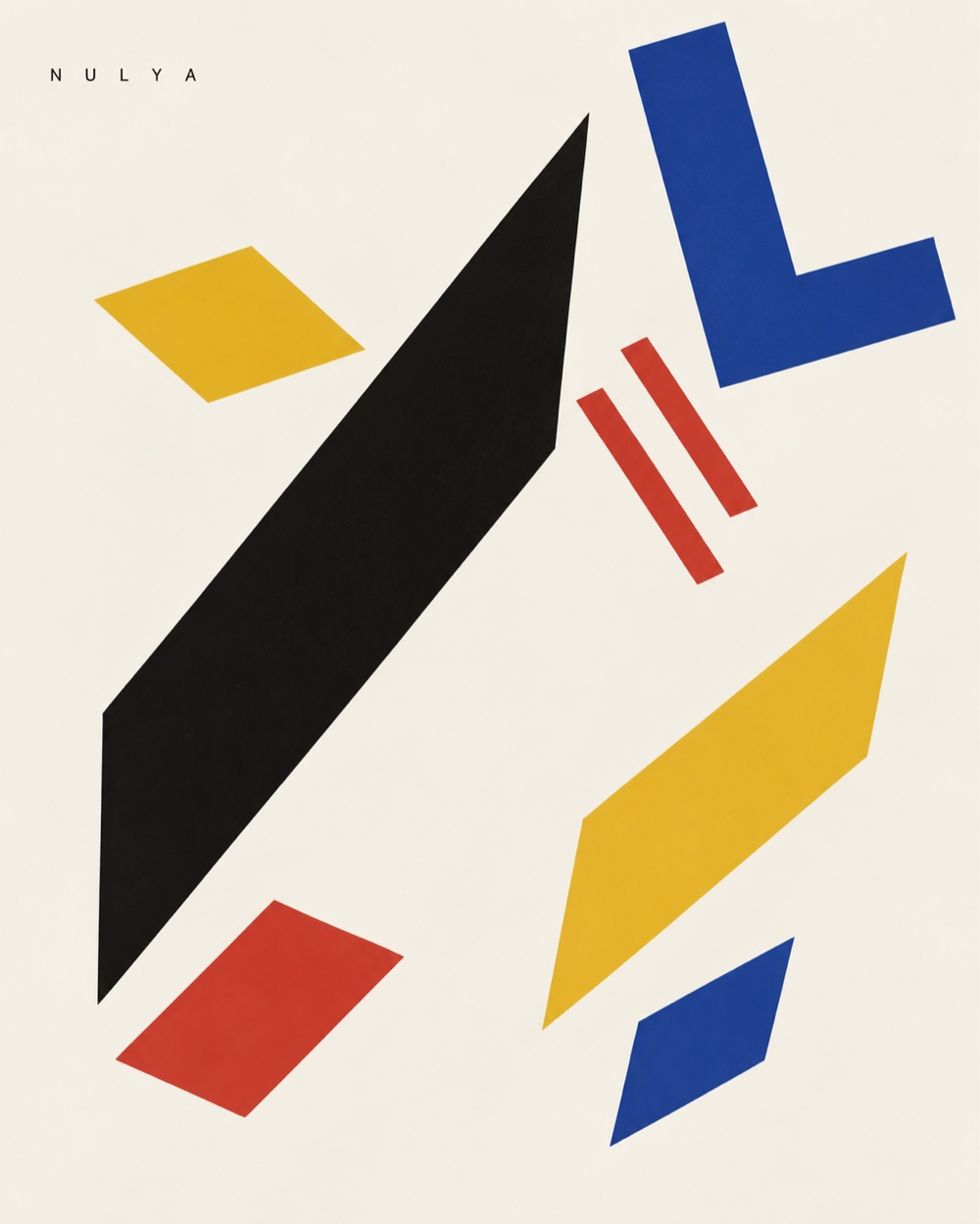
Nulya is a small gallery on the Fontanka that shows only non-objective painting. Its name comes from the Russian for zero. The identity is drawn from the Remade poster: a black slab, a blue L, yellow and red planes and two thin red bars, all crossing an open cream field. Each plane is cut the same way, with two edges on one steep diagonal and two edges dropped plumb. That shared cut is what makes a loose scatter read as one flight.
- Client
- Nulya, gallery of new painting
- City
- Petrograd
- Style
- Suprematism
- Year
- 1916
- The rule
- One diagonal at 50°. Two edges on it, two edges plumb. The blue L is the only right angle. No ground.
Mark
The mark is the poster's opening move: a black slab climbing the diagonal and a blue L standing clear of it, with two red bars between them. The L is the only shape with a right angle, so it is the only one allowed to turn.
Jost Regular, caps, tracked +620, set small and level in a corner, as on the poster. The shapes do the shouting. The name stays quiet and readable.
Mark on the field
Reversed on black
Under 12 mm: the red bars drop out
The rule running
Every Nulya composition is built the same way: pick the diagonal, cut each plane with two edges on it and two edges plumb, then let the pieces drift. Square the corners and the planes turn into tipped boxes. Add a floor and they become a still life.
In flightEvery plane leans on one 50° diagonal and nothing touches a floor.
Each press builds a new arrangement from the poster's parts: one black slab, one blue L, two or three coloured planes, a pair of thin red bars and a few splinters.
Colour
Five flat colours sampled from the poster, used in fixed proportion. The cream field is most of every surface. Black carries the weight, yellow carries the light, blue is the L, red is the spark. No tints, no gradients, no shadows.
Warm cream. Never white, never framed.
One slab per piece, and the text.
The second plane. Can be large.
The L, plus one small plane at most.
The twin bars and one small plane.
Type
The poster carries one line of type: the name, small, light and widely spaced in a corner. The identity keeps that restraint. Jost does everything, level, never on the diagonal. It carries Cyrillic, so both of the gallery's languages share one voice.
Display · Jost Regular, caps, tracked +500
New paintingЖивопись без предмета
Text · Jost Regular, 17 / 28
The gallery opens at noon and closes when the light goes. Forty-one works hang in two rooms. Nothing on the walls shows a thing you could pick up.
- DisplayCaps, tracked wide, small. Sits in a corner, about 7% in from the edges.
- TextSentence case. Level. Never above 20 px.
- NeverType on the diagonal. The planes lean. The words do not.
Applications
The same parts rearranged for each format. The poster flies the whole set. The catalogue reverses it onto black. The ticket keeps the slab and the bars. The wall label is level, with one red plane to tie it back.
Colour masses in the fourth dimension
Oil on canvas, 1915. Lent by the artist.
Voice
Short and certain, with as few words as the poster. Nulya never explains a painting. It says what has been removed and lets the shapes speak.
The objects have left. Come and see what stayed.
Season line. Used inside the catalogue, never on the poster. The poster carries only the name.
Nulya saysForty-one paintings of nothing you can hold.
NotA stunning collection of abstract masterpieces.
- Say what is gone. The gallery describes painting by subtraction: no horizon, no model, no story.
- One claim per line. Sentences stop at the full stop. No lists of adjectives.
- Russian leads. Every public line is written in Russian first. Latin script follows for foreign visitors.
- Numbers, not praise. Count the works, give the hours, name the street.
What breaks it
The system fails the moment the shapes stop leaning together. Square corners, a second slant or a floor each pull the planes back into the world of objects.
- Square cornersA rectangle tipped on the diagonal reads as a box falling over. The plumb cut is what makes it lean.
- A second slantPlanes leaning different ways read as a crash, not flight. One diagonal per piece. The twin bars cross it square, nothing else does.
- A ground lineAny horizon or floor gives the shapes somewhere to sit. They become objects on a table.
- Loud typeBig or slanted type competes with the planes. The name stays small, level and in a corner.
Lesson for students and teachers: Suprematism, 1916
The rule behind Nulya
Remove the horizon. Once nothing is standing on anything, a few tilted shapes feel like movement.
Kazimir Malevich · 0,10 exhibition and the Suprematist compositions · 1915–16
Learn how it works
Malevich stripped painting down to what he called the zero of form: squares, bars and circles floating on white, at angles that suggest flight rather than rest. Lissitzky and the Constructivists took these shapes straight into typography a few years later.
Learn to spot it
A black square, bars of red, blue and yellow tilted on one diagonal, a white field with no ground line, and very little text.
Use the idea yourself
Remove the horizon. Once nothing is standing on anything, a few tilted shapes feel like movement.
Make something (10 minutes)
Arrange five paper rectangles on a page with no top or bottom. Turn the page round. Does it still work?
Talk about it
“What happens to a picture when there is no ground to stand on?”