Rombo Futurism · 1914
Scroll down for the full brand identity study.
Rombo
Map the sound of your subject onto size and angle. The reader hears the page before reading it.
↓ Scroll to the Rombo brand identity system below · View in the archive
Prints are in preparation and are not available to order yet. Frame and room views are visual simulations; they do not confirm the final product, scale or finish.
The identity system below is drawn from the Remade poster.
Rombo
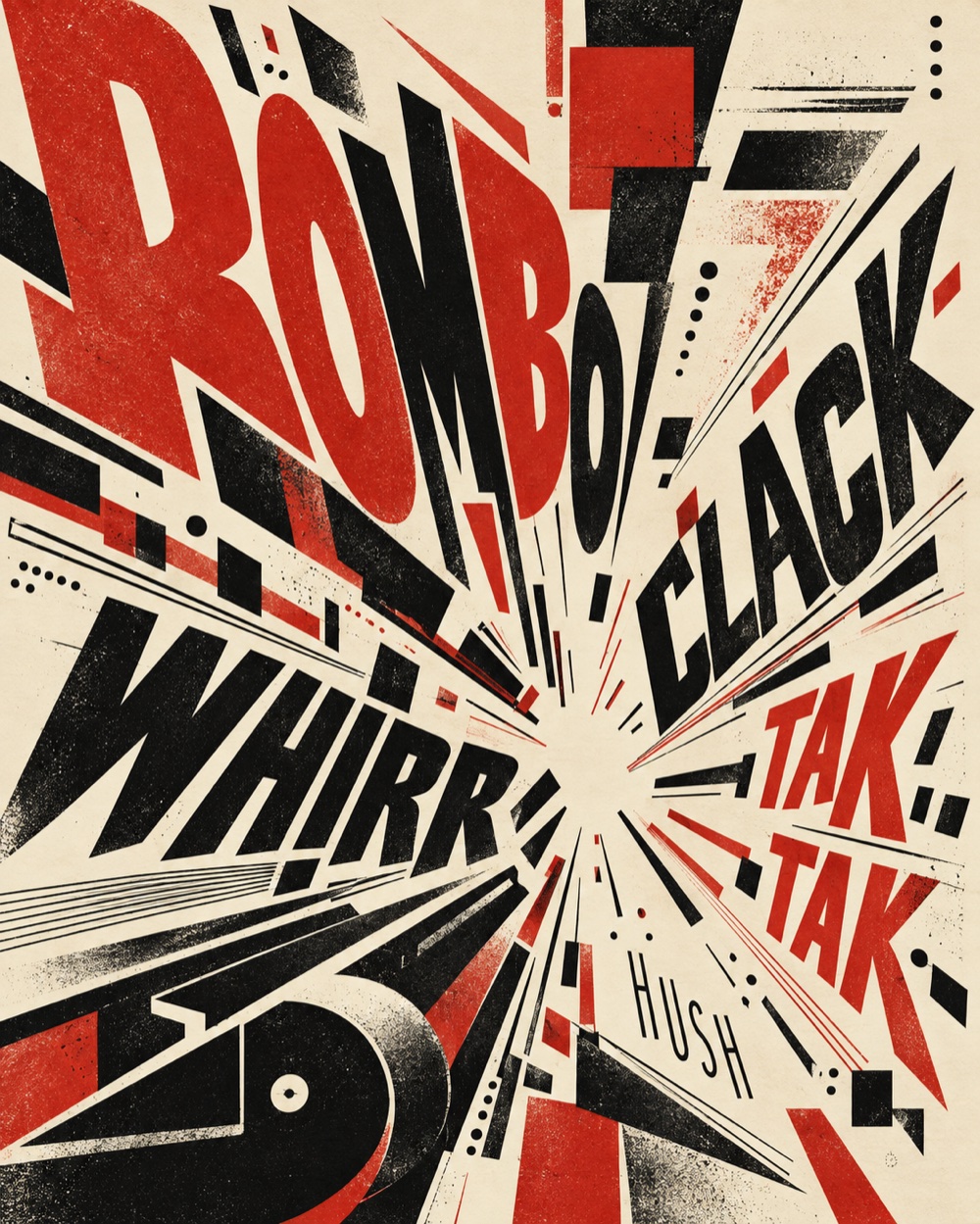
Every sound bursts out of one point. Rays and speed wedges fan from it and the words ride the rays, growing as they fly out: heavy condensed italics in black and red, with one quiet word left small.
Evening bill, 50 × 62.5 cm
Brand guidelines
There is always one point, and everything leaves it. Rays and wedges fan out, and each word rides a ray, so its angle is set by where it is, never by taste. Words grow as they travel. Heavy condensed italics only, in black or red. One word is always quiet: small, light and spaced, so the noise has something to be loud against.
Card, 85 × 55 mm
What breaks it
Set the words level, in a tidy column, with even spacing and polite line height, and the sound stops. Nothing is moving and nothing is loud.
The burst needs a centre. Scatter words at random angles with no point to leave from, and it reads as a mess, not as noise.
Rombo
Clack. Whirr. Tak tak. Hush.
An evening of machines and music, with readings and a short demonstration. Doors at eight.
Lesson for students and teachers: Futurism, 1914
The rule behind Rombo
Map the sound of your subject onto size and angle. The reader hears the page before reading it.
F.T. Marinetti · Zang Tumb Tuuum and the parole in libertà · 1912–19
Learn how it works
Marinetti wanted type to make noise. He broke the line, sized words by how loud they were, slanted them by how fast, and scattered them around the point where the action happened.
Learn to spot it
Onomatopoeia, words at steep angles, radiating lines, typefaces of every weight on one page, maths symbols as punctuation, and almost no conventional sentences.
Use the idea yourself
Map the sound of your subject onto size and angle. The reader hears the page before reading it.
Make something (10 minutes)
Pick a sound from school: the bell, the canteen, a PE whistle. Set the word so it looks the way it sounds, using type only.
Talk about it
“Can type be loud without being big?”