Kukka Finnish textile · 1964
Scroll down for the full brand identity study.
Kukka
Scale is a design decision. Blow one simple motif up past the frame and it turns into a system.
↓ Scroll to the Kukka brand identity system below · View in the archive
Prints are in preparation and are not available to order yet. Frame and room views are visual simulations; they do not confirm the final product, scale or finish.
The identity system below documents the original design study, made before the current poster artwork.
Kukka
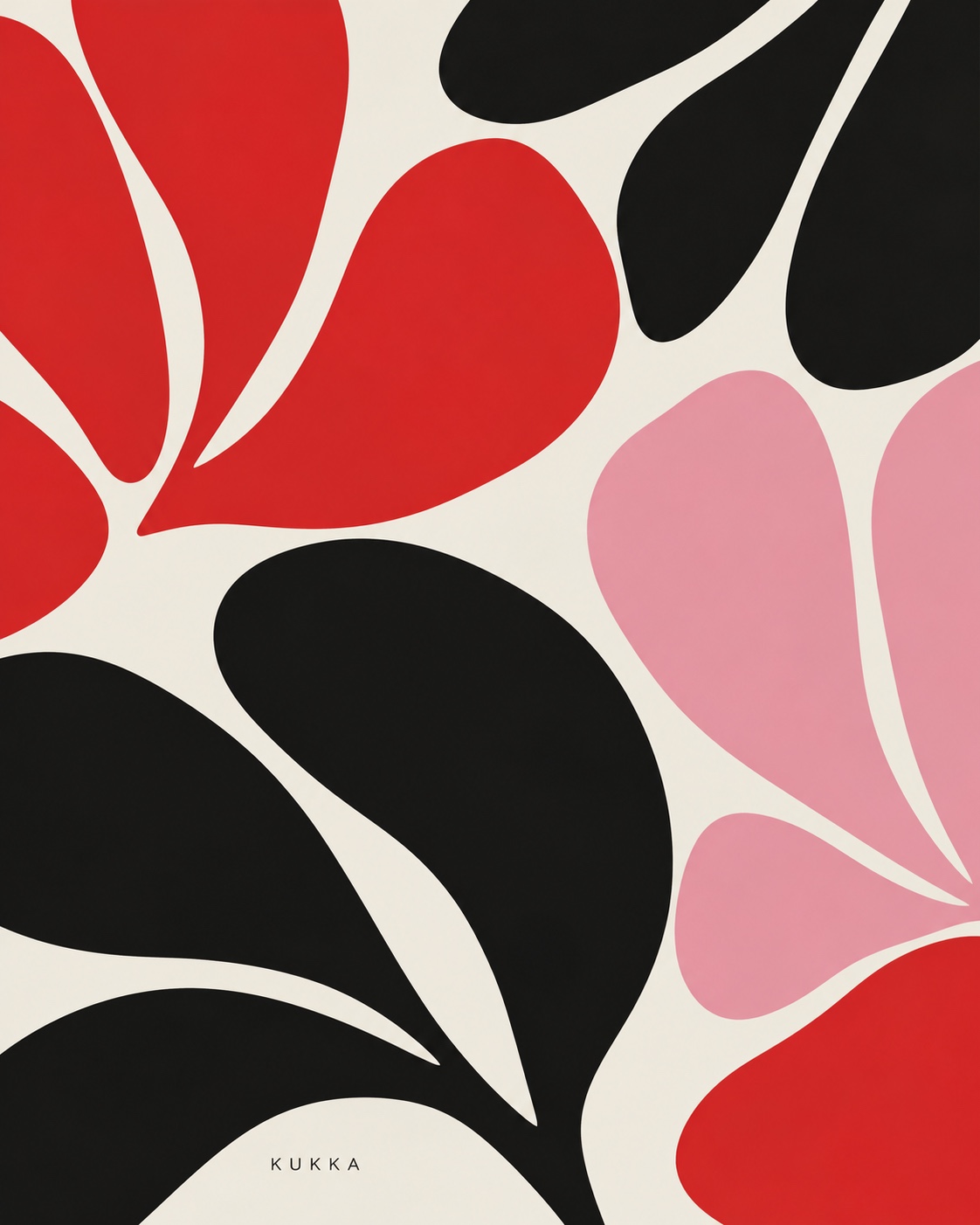
A plant drawn so big and so flat it stops being a plant and becomes a repeat. The print runs off every edge, cut from a length of cloth.
Helsinki 1964 Kukka Maija Isola
Brand Guidelines
Scale is everything. The motif must be large enough that it becomes abstract pattern — never small enough to be read as illustration. No gradients. No shading. Flat colour only. The print must bleed every edge with no visible background.
What breaks it
Placing a small version of the motif centrally on a white background, surrounded by generous white space — treating it like a corporate logo. The plant becomes decoration again. The rule is that it must be so big it ceases to be a plant and becomes the entire surface.
Lesson for students and teachers: Finnish textile, 1964
The rule behind Kukka
Scale is a design decision. Blow one simple motif up past the frame and it turns into a system.
Maija Isola · Marimekko printed cottons · 1964
Learn how it works
Isola drew plants at a scale no textile had used, with blunt flat forms and no shading, and printed them by hand on cotton. Cropped by the edge of a dress or a curtain, a seed head or a stem became pure shape and colour.
Learn to spot it
Oversized flat organic shapes, no outline and no shading, two or three strong colours plus black, deliberate cropping at the edges, and very little type.
Use the idea yourself
Scale is a design decision. Blow one simple motif up past the frame and it turns into a system.
Make something (10 minutes)
Take one small shape and scale it up until it crops off the edges of the page. Repeat it to make a pattern.
Talk about it
“Why does cropping make a shape feel bigger?”