Kerb Flat illustration · 2017
Scroll down for the full brand identity study.
Kerb
Make the drawing say the sentence. The style is empty when a figure gestures at nothing; it works the moment each figure performs the exact action the caption names.
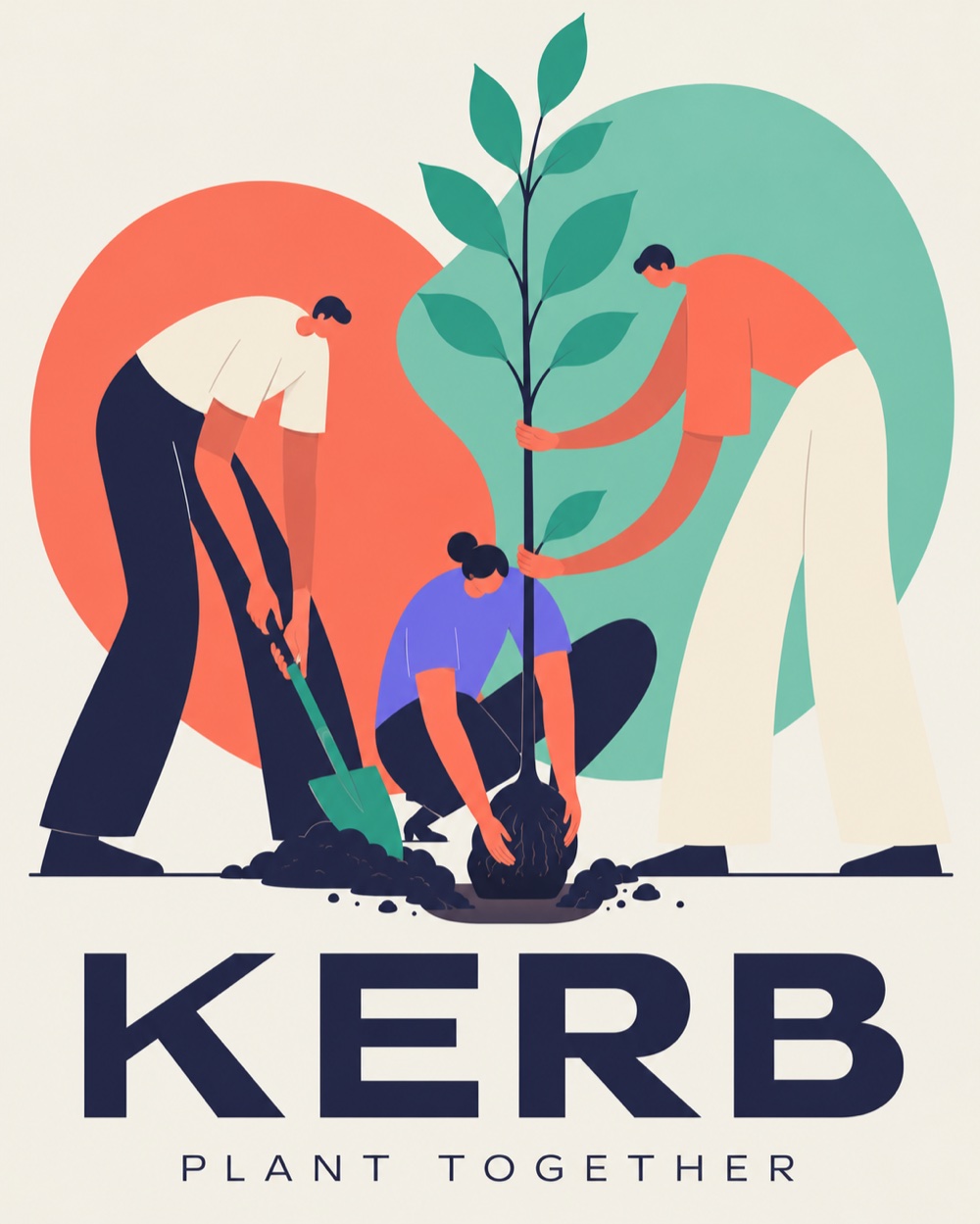
↓ Scroll to the Kerb brand identity system below · View in the archive
Prints are in preparation and are not available to order yet. Frame and room views are visual simulations; they do not confirm the final product, scale or finish.
The identity system below documents the original design study, made before the current poster artwork.
Every figure is doing the sentence.
Kerb teaches seven-year-olds in Leeds how to cross a road. Flat illustration is the right tool for that and the wrong tool for almost everything it gets used for. The rule is the difference: a Kerb figure performs the exact action in the line beside it. If a drawing would work equally well next to any other sentence, it is cut rather than reused.
- Client
- Kerb (invented)
- Place
- Leeds
- Style
- Corporate Memphis / flat illustration
- After
- The 2017–22 flat-figure house style
- Type
- Fredoka; Karla for reading
- Test
- One sentence, one action, or it is deleted
The mark is a kerb and someone on it
A figure standing at the edge, which is the moment the whole campaign is about. The kerb is a real profile: 125 mm, the Leeds standard.
The mark, its one-colour cut, and the wordmark alone which is not permitted
- The kerb
- 125 mm at 1:10, the height a child actually steps down. Drawn to scale because the campaign is about a real edge, not the idea of one.
- Always together
- Figure and word. The word alone is a charity; the figure alone is a pictogram. The campaign is the pair.
- Proportion
- Seven heads tall, which is roughly a child. The style’s long-limbed adults are the single most recognisable thing about it and they are not used here.
- Never
- Never mid-leap, never floating, never with an arm longer than a leg. The figure is standing on something and you can always see what.
Pick a line and watch the figure change
Four sentences, four actions, four drawings. Every figure is doing the specific verb. The last one is the test: a sentence with no action gets no figure at all.
- The test
- Cover the sentence. If you can still tell which one the drawing belongs to, it passes. If it could sit beside any of them, it is decoration and it goes.
- One verb
- Each drawing carries exactly one action. Two actions in a frame and a seven-year-old reads neither.
- No figure
- Some lines have no action. Those get a diagram, a photograph of the junction, or nothing. Inventing a figure to fill the space is how the style rotted.
- Faces
- Eyes only, no mouth. A smile on a road-safety figure tells a child the situation is fine, which is the opposite of the message.
Four colours, and three of them mean something
Not a pastel set. The figure is one colour so children recognise it as the same person every time, and the road is dark so the figure always reads against it.
#D36A55Every person, every time. Never used for anything that is not a person.#2F4858Tarmac, vehicles and all body text. The thing you are being taught to respect.#F2B705Only where a child must look or stop. Never a background for a whole poster.#2E7D5BThe pavement and the far side. Where the figure is allowed to be.- One skin colour
- Deliberately non-human orange, so the figure is every child rather than a particular one. This was the most argued decision in the project.
- Not pastel
- The style’s usual washed lilacs and mints fail against a printed road surface and in a school corridor under fluorescent light.
Rounded for the child, plain for the adult
The rounded face carries anything a seven-year-old reads. Everything a parent, teacher or road-safety officer reads is set in the plain sans, because it is longer and duller and needs to be read at length.
Fredoka 700Stop at the kerb
Fredoka 600Look right, left, right again
Karla 400Kerb is delivered in Year 3 across 41 Leeds primaries. The session is 45 minutes and includes one supervised crossing on a real road.
Karla 700Session 2 of 4 · Year 3 · 45 min
Applications
A classroom poster, a leaflet for parents, a school-gate sign, a card and the site. The figures differ on every one because the sentences do.
Stop at the kerb.
Classroom poster, A2 · one line, one action
Card, 85 × 55 mm
Stop at the kerb, before the road.
Look right, left, and right again.
Listen for anything you cannot see.
Walk straight across, keep looking.
Parent leaflet, A4 · one figure per step
Look there. School gate · Kerb
School-gate sign, 600 × 450 mm
Forty-five minutes, and one real crossing.
Delivered in Year 3 across 41 Leeds primaries. Free to schools.
Book a sessionWebsite
Voice
Two audiences and two registers. To a child: an instruction they can follow while standing on a pavement. To an adult: what happens, how long, and what it costs.
Stop at the kerb. Look right, left, right again.
A sequence a seven-year-old can do without an adult present.Be safe and smart near roads!
No action in it. A child cannot do “be smart” at a junction.45 minutes, Year 3, one supervised crossing on a real road.
What a head teacher needs to decide whether it fits the timetable.Empowering young people to make safer choices.
Written for a grant panel, not for the person booking the session.What breaks it
This style is a punchline for reasons, and all four of them are here. The first is the one that made it one.
Kerb is invented, built as a portfolio exercise in flat illustration. Leeds, its primary schools and the 125 mm kerb standard are real; this campaign, its figures, sessions and staff are not, and nothing here is road-safety guidance. The visual language is after the flat-figure house style of about 2017 to 2022. Those illustrators are credited as influences only. Part of the One Rule Each series.
Every figure performs the exact action in the sentence beside it. A figure that could illustrate any sentence is deleted, not redrawn.
Lesson for students and teachers: Flat illustration, 2017
The rule behind Kerb
Make the drawing say the sentence. The style is empty when a figure gestures at nothing; it works the moment each figure performs the exact action the caption names.
the flat-illustration house style · Alegria · 2017
Learn how it works
Flat vector people, no faces, limbs longer than anatomy allows, drawn in a palette of three muted brand colours. It became the default illustration of the funded-startup decade because it scales to any subject and offends nobody.
Learn to spot it
Small heads, elongated arms, rounded blob shapes behind the figures, one flat weight of line, a single ground rule.
Use the idea yourself
Make the drawing say the sentence. The style is empty when a figure gestures at nothing; it works the moment each figure performs the exact action the caption names.