Molten Chrome 2.0 · 2020
Scroll down for the full brand identity study.
Molten
Fix the metal as six stops in one order and vary only the angle. Every chrome object on the sheet then belongs to the same material; picking new colours per object gives you tinfoil.
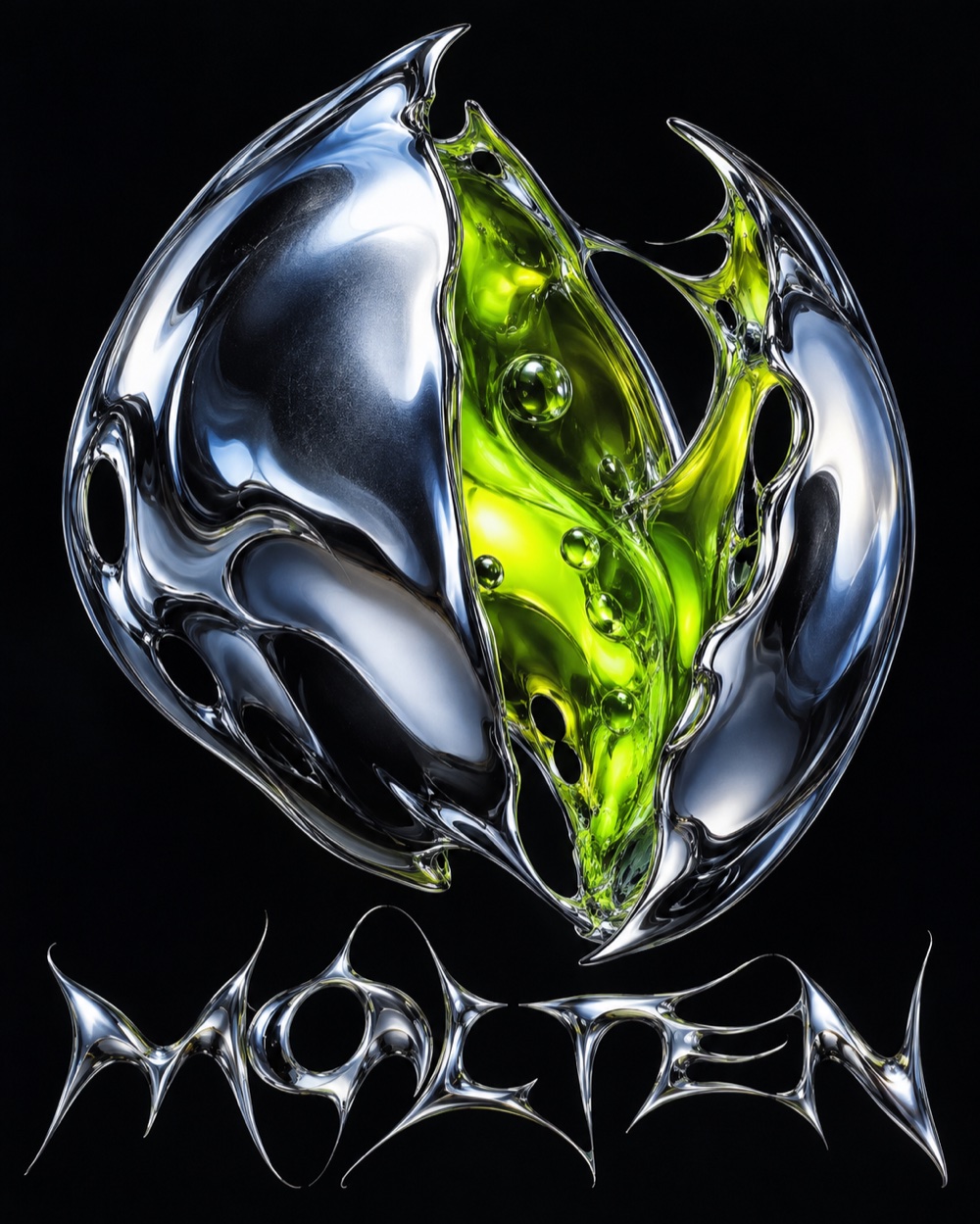
↓ Scroll to the Molten brand identity system below · View in the archive
Prints are in preparation and are not available to order yet. Frame and room views are visual simulations; they do not confirm the final product, scale or finish.
The identity system below documents the original design study, made before the current poster artwork.
Six stops. One angle.
Molten is a monthly club night in a former foundry in Antwerp. Chrome is the whole look and chrome is where this style dies, because everyone treats it as an effect. Here it is a ramp: six stops in a fixed order. The angle is the only thing anyone is allowed to change, and changing it is enough.
- Client
- Molten (invented)
- Place
- Antwerp, Nieuw Zuid
- Style
- Acid graphics / chrome 2.0
- After
- The 2020 onward Y2K-through-3D revival
- Type
- Archivo Black; a blackletter for one word
- Ramp
- 6 stops, fixed order, angle free
The mark is the word, cast
Set in the heaviest grotesque and filled with the ramp. It is not a metal effect applied to type; it is the same six stops that fill every other surface, clipped to letters.
The mark at two angles, and the flat cut it falls back to
- Below 24 px
- Flat. A six-stop ramp inside a small letterform is mud, so the small cut is solid ink and there is no argument about it.
- One angle per artefact
- Everything chromed on a given piece shares its angle, because two angles in one frame reads as two light sources and the illusion goes.
- Never outlined
- A stroke around chromed type flattens it instantly. If the mark will not hold on a background, the background changes.
- Never animated
- The ramp does not sweep. Moving it turns a material into a screensaver, which is the tell of the whole revival done badly.
Turn the angle
One control. The stops and their positions never move; only the direction of the ramp does. That is the whole system, and it is why two posters a year apart still match.
- Why six
- Metal needs at least two dark-to-light reversals to read as reflective. Five is nearly enough and seven starts to band on a laser print.
- The dark band
- Stop three sits at 33% and is the darkest. It is the horizon in the reflection, and moving it is what makes chrome look like plastic.
- On print
- The same six as a duotone of silver and black. It loses the blue and it still reads as metal, which is the test of whether a ramp is a real one.
The ramp, an acid and a hot pink
Chrome is not a colour, so the palette is two: one acid for anything you can act on and one hot pink for the blackletter. Everything else in the system is the ramp or the void.
6 stops · fixedEvery surface, every mark. Not a colour and never listed as one.#C6FF3DTickets, times, anything clickable. Carries dark type only.#FF2E6BThe blackletter word and nothing else, once per artefact.#08070BThe ground. Nearly black so the ramp has something to reflect into.A grotesque and one gothic word
Archivo Black does everything. Exactly one word per artefact is set in the blackletter, and it is always the name of the night, never a headline and never a date.
Archivo BlackFoundry floor
BlackletterMolten
Archivo 400Doors at eleven, last entry at two, and the room is a working foundry until six on the Friday, so nothing is set up before eight.
Archivo 600, spacedSat 14 Mar · 23:00 – 06:00 · €18
- One word
- Blackletter beside a grotesque is the tell of this style and also its trap. One word is a signature; two is a costume.
- Never the details
- No date, price or address is ever set in the gothic. People read those at four in the morning on a phone.
Applications
A flyer, a sleeve, a ticket and the site. Each has one angle, one acid element and one gothic word, and the rest is the ramp against the void.
014
Flyer, A5 · angle 168°
Ticket · the acid does the tear-off
Record sleeve, 12″ · angle 96°
014
Foundry
floor
Sat 14 March, 23:00 until 06:00. Two rooms, one of them still a foundry.
Tickets €18Website · angle 212°
Voice
The look is extravagant so the words are not. Times, prices and the state of the room, written the way you would tell a friend who is deciding whether to come out.
23:00 to 06:00. €18 advance, €22 on the door.
The two things anyone actually needs, in the order they need them.An immersive audiovisual journey into sound.
Every club night has said this since about 2016.It is a working foundry. It is loud, it is cold, and there is no cloakroom.
Tells people what they are walking into, which is respect rather than a warning.A truly unforgettable night awaits.
Promises an outcome nobody can be held to and nobody believes.What breaks it
This style went from novel to exhausted in about eighteen months, and these are the four reasons. The first is the one that turns metal into plastic.
Molten is invented, built as a portfolio exercise in the chrome and acid-graphics revival. Antwerp and Nieuw Zuid are real; this club night, its dates, prices and venue are not. The visual language is after the Y2K-through-3D revival of about 2020 onward and the sleeve design it borrows from. Those designers are credited as influences only. Part of the One Rule Each series.
Six stops at fixed positions, in one order. The angle is the only variable, and one artefact has one angle.
Lesson for students and teachers: Chrome 2.0, 2020
The rule behind Molten
Fix the metal as six stops in one order and vary only the angle. Every chrome object on the sheet then belongs to the same material; picking new colours per object gives you tinfoil.
the chrome 2.0 sleeve · acid graphics · 2020
Learn how it works
Liquid metal rendered in a browser: blobs, warped type and a chrome finish built out of a gradient rather than a render. The acid green is there to stop the metal reading as luxury.
Learn to spot it
Blown-out highlights next to near-black, a soft blob form, one fluorescent accent, and type filled with the same metal as the object.
Use the idea yourself
Fix the metal as six stops in one order and vary only the angle. Every chrome object on the sheet then belongs to the same material; picking new colours per object gives you tinfoil.