Mirage Album cover surrealism · 1968
Scroll down for the full brand identity study.
Mirage
Make one thing wrong and keep everything else plausible. Surprise needs a believable setting to land.
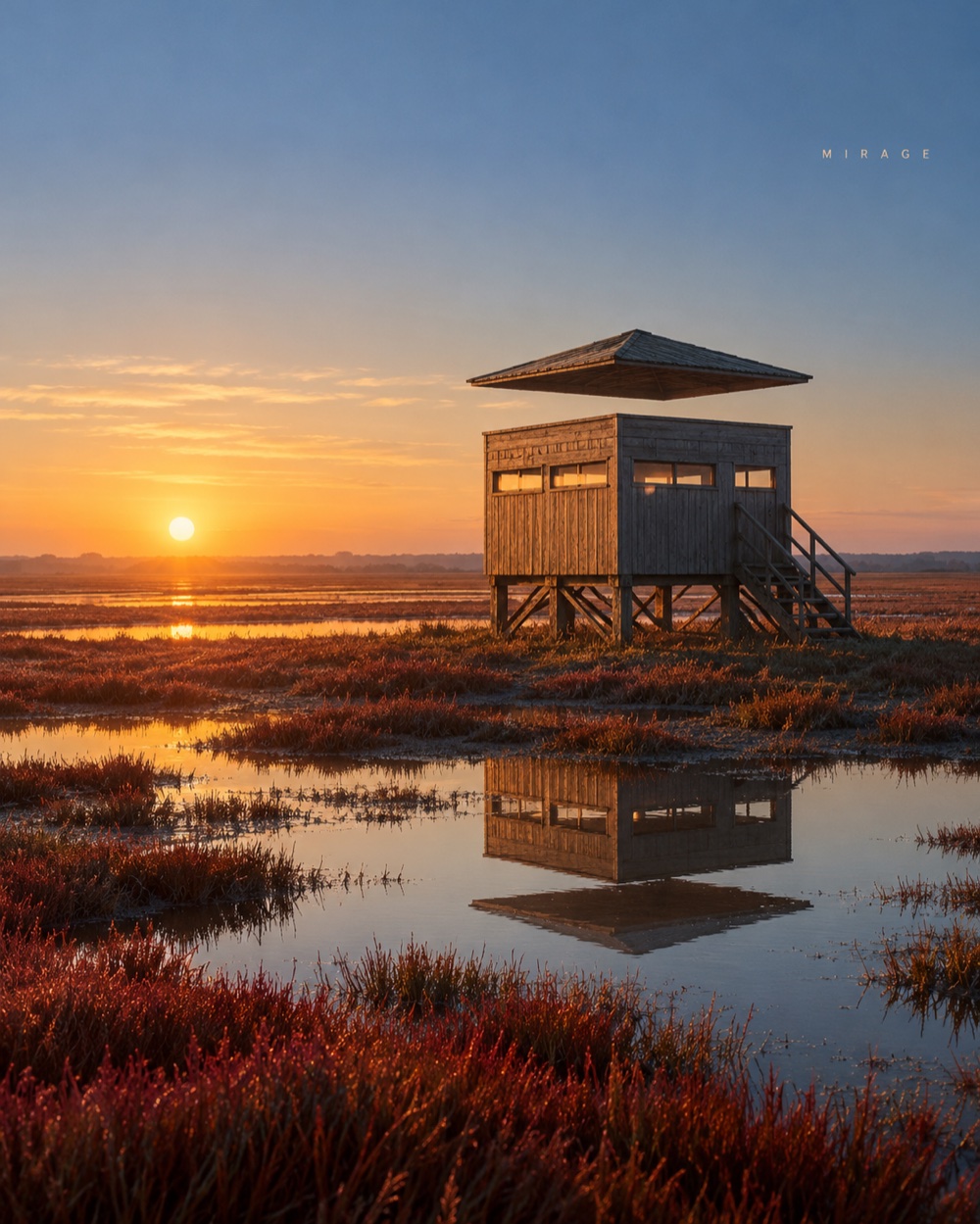
↓ Scroll to the Mirage brand identity system below · View in the archive
Prints are in preparation and are not available to order yet. Frame and room views are visual simulations; they do not confirm the final product, scale or finish.
The identity system below documents the original design study, made before the current poster artwork.
Make one thing wrong. Keep everything else true.
Mirage is a four-piece from Camden with two albums and a reputation for long songs. Their sleeves follow Hipgnosis: an ordinary landscape photographed plainly, and one thing in it that cannot be. A stone hangs over the dunes. A bed sits in the surf. It was built and photographed for real, so the light and the shadows are true. The band's name never goes on the front.
- Client
- Mirage, rock band
- City
- London
- Style
- Surreal album art
- Year
- 1973
- The rule
- One impossible thing. Documentary light. Low sun. No name on the front.
Mark
On the sleeve there is no logo. Off the sleeve the band uses a small stone and its shadow: an object that should be on the ground, and a shadow that proves it is not. The name is set in widely spaced capitals, quietly, like a caption.
Mirage
The Long Afternoon
Jost Regular in capitals, tracked +500, never bold. It appears on the spine, the back and the label. Never on the front.
On sky
The spine
Smallest: stone and shadow
The rule running
Stage a sleeve. Choose the impossible thing and move the sun. A high sun flattens the shadows and the trick looks pasted on. A second wonder turns it into a circus. The band's name turns it into an advert.
BelievableOne wrong thing, a low sun and long shadows.
Everything in the frame is built and photographed for real. The rig only simulates the light.
Colour
The palette is whatever the camera saw at the end of the day: pale sky, warm sand, deep shadow. The only colour the designer adds is one strong red, and only when it belongs to the impossible thing.
Upper frame.
Light ground, paper and inner sleeve.
Lower frame.
Shadows and back-cover text.
The impossible thing, at most.
Type
Type lives on the back, the spine and the label, set small and plain in Jost so it never competes with the photograph. Capitals are tracked wide. Track titles are sentence case.
Name · Jost Regular, caps, +400
Mirage
Back cover
- 1. Heat haze
- 2. Salt road
- 3. The stone
- 4. Low sun
- 5. Tidewater
- 6. The long afternoon
Text · Jost Regular 17 / 28
Photographed at Merzouga at 6.40 in the evening. The stone weighs forty kilos and was hung from a crane jib, removed from the print by hand.
- FrontNothing. No name, no title, no sticker.
- BackJost 400 at 9 pt, tracks and credits, flush left.
- NeverChrome, distressed or psychedelic lettering.
Applications
The front is a photograph and nothing else. Words move to the back, the spine and the tour poster, where the audience needs facts. The same stone recurs, so the fans learn to recognise the band by it.
Voice
Deadpan. The band describes its sleeves as if they were ordinary photographs, and describes ordinary things as if they were strange. It never explains the joke.
Nothing was retouched. We just waited for the light.
Sleeve note, back cover of The Long Afternoon.
Mirage saysThe stone weighs forty kilos. It took three days to hang.
NotA mind-bending cosmic journey through sound and vision.
- Plain facts about strange things. Weights, places and times. The oddness does the talking.
- No adjectives about the music. Never trippy, epic or mind-bending.
- Keep the secret. How the picture was made is shared. What it means is not.
- Name last. The band's name comes after the title, after the tracks, after the credits.
What breaks it
The trick depends on everything else being ordinary. It fails when the light is wrong, when there is too much magic, or when the sleeve starts selling.
- Noon lightShort, hard shadows make the impossible thing look cut out and stuck on.
- Two wondersA second strange thing turns a riddle into a fairground.
- The name on the frontBig lettering turns the photograph into packaging.
- Fake it on the pageIf the object was never really there, the light will give it away.
Lesson for students and teachers: Album cover surrealism, 1968
The rule behind Mirage
Make one thing wrong and keep everything else plausible. Surprise needs a believable setting to land.
Storm Thorgerson and Aubrey Powell · Hipgnosis album covers · 1968–83
Learn how it works
Before retouching software, Hipgnosis built their surreal ideas for real: people on fire, beds on beaches, objects hanging in the desert, photographed in camera. The band name was often left off the cover entirely.
Learn to spot it
A single impossible object in an ordinary landscape, a calm documentary photograph, long shadows and a low sun, and little or no type on the front.
Use the idea yourself
Make one thing wrong and keep everything else plausible. Surprise needs a believable setting to land.